

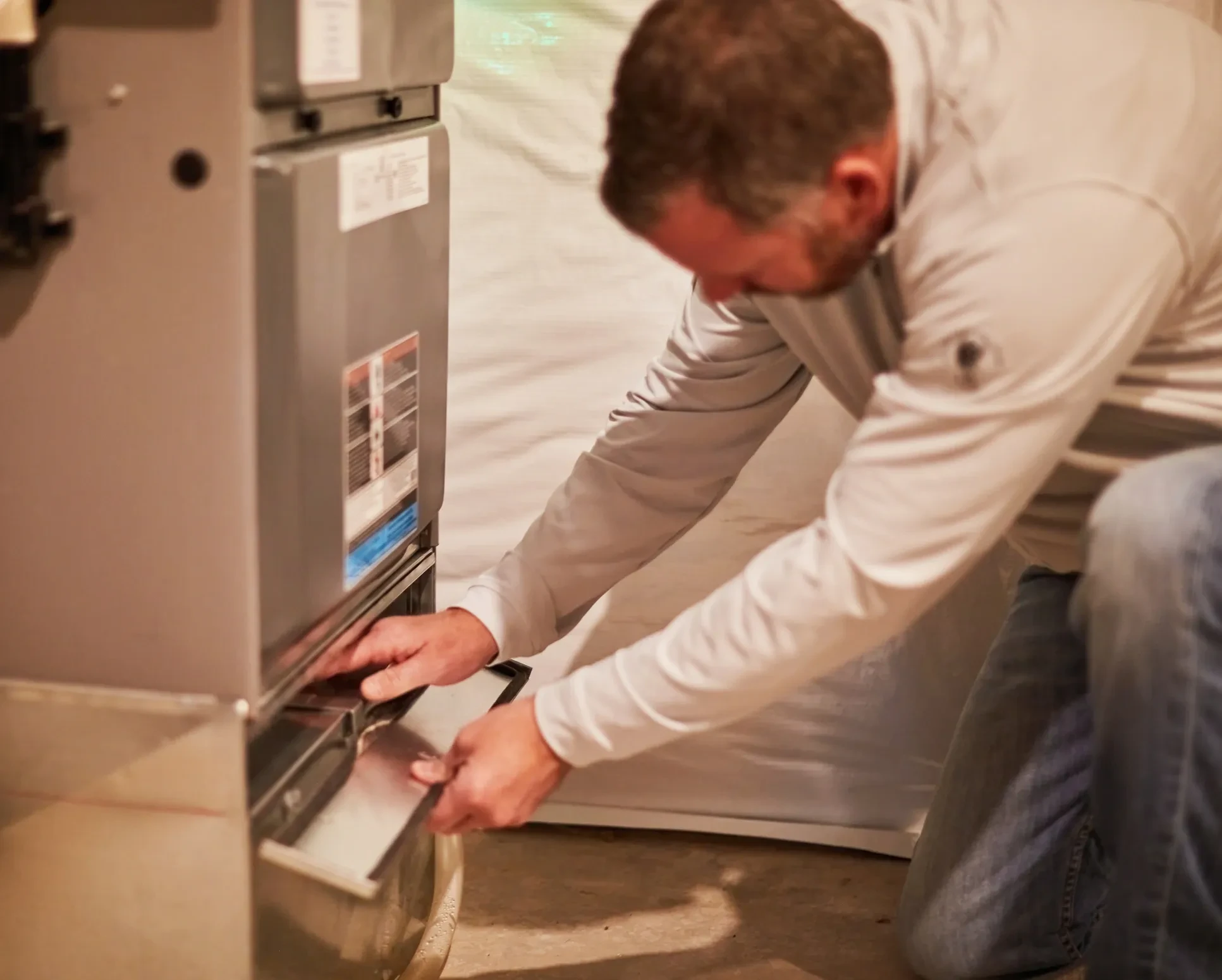

What Makes a Furnace "High-Efficiency"?
In the HVAC industry, "high-efficiency" typically means 90% AFUE or above. The U.S. Department of Energy requires a minimum of 80% AFUE for new furnaces sold in the northern U.S. (including Illinois). Anything above 90% is considered high-efficiency; 96%+ is premium efficiency.
AFUE (Annual Fuel Utilization Efficiency) measures how much of the gas you burn actually becomes heat in your home. An 80% AFUE furnace wastes 20 cents of every dollar of gas. A 96% AFUE furnace wastes only 4 cents.
How Condensing Furnaces Work
Standard 80% furnaces vent hot exhaust gases (around 400°F) through a metal flue pipe. All that heat goes outside — that's the 20% waste.
High-efficiency condensing furnaces add a second heat exchanger that extracts additional heat from those exhaust gases. By the time the gases exit the furnace, they've cooled to around 100–120°F — so cool that water vapor in the exhaust condenses into liquid. That condensate drains away through a PVC pipe.
Because the exhaust is so cool, it can be vented through inexpensive PVC pipe instead of metal flue pipe. This is why high-efficiency furnaces vent through the side of the house (two PVC pipes — one intake, one exhaust) rather than up through the roof.
The Two-Heat-Exchanger Design
The primary heat exchanger handles the initial combustion heat — same as an 80% furnace. The secondary heat exchanger (the condensing coil) captures the remaining heat from the exhaust gases. Together, they extract 90–99% of the available heat from the gas.
The condensate produced is slightly acidic (pH around 3–4). It drains through a neutralizer (required by code in many areas) before entering the drain. If the condensate drain clogs, the furnace will shut down — a common service call in winter.
96% vs. 98–99% AFUE: Is the Premium Worth It?
The efficiency difference between a 96% and 99% furnace is 3 percentage points. On a $1,200/year gas bill where the furnace accounts for roughly 60% ($720), that 3% difference saves about $22/year. The price premium for a modulating 99% furnace over a two-stage 96% unit is typically $2,000 to $4,000.
The math on pure efficiency payback rarely works out for the top-tier modulating furnaces. What you're actually buying with a modulating furnace is comfort — virtually no temperature swings, near-silent operation, and better humidity control. If those things matter to you, the premium is justified. If you just want efficient heat, a 96% two-stage unit delivers most of the efficiency benefit at a lower cost.
Chicago-Specific Payback Analysis
Chicago averages around 6,500 heating degree days per year — one of the higher figures in the continental U.S. That means your furnace runs a lot, which improves the payback on efficiency upgrades compared to milder climates.
Rough annual savings switching from 80% to 96% AFUE in a typical Chicago home (1,500–2,000 sq ft):
- Small home (1,000 sq ft): ~$150 to $200/year
- Medium home (1,500–2,000 sq ft): ~$250 to $350/year
- Large home (2,500+ sq ft): ~$400 to $600/year
At $300/year savings and a $1,500 price premium for the high-efficiency unit, payback is 5 years. That's reasonable for a system that will last 15–20 years.
Installation Differences
Venting: High-efficiency furnaces require two PVC pipes (typically 2" or 3" diameter) — one for combustion air intake, one for exhaust. These are usually run through an exterior wall. If you're replacing an 80% furnace, the existing metal flue is abandoned (or repurposed for a water heater).
Condensate drain: A drain line must run to a floor drain, utility sink, or condensate pump. If no drain is nearby, a condensate pump is added — a small device that pumps the water to a drain location.
Gas line: High-efficiency furnaces often require the same gas line size as standard units. Your contractor will verify this during the installation assessment.
Top High-Efficiency Models We Install
- Lennox SLP99V — up to 99% AFUE, modulating, variable-speed. The benchmark for residential efficiency.
- Lennox EL296V — 96% AFUE, two-stage, variable-speed. Excellent value in the premium tier.
- Carrier Infinity 98 — 98% AFUE, modulating, variable-speed. Strong communicating system integration.
- Goodman GMVC96 — 96% AFUE, two-stage, variable-speed. Best value in the high-efficiency category.
Rebates for High-Efficiency Furnaces
Nicor Gas offers rebates for qualifying high-efficiency furnace installations in Illinois — typically $100 to $300 depending on AFUE rating. ComEd rebates may also apply if the furnace includes a variable-speed ECM blower motor. Federal 25C tax credits may apply for qualifying equipment. Ask your contractor to confirm current rebate availability before purchasing.